Thursday, 20 September 2018

Norman Conquest 1066


.
.Norman Conquest 1066

The Norman conquest of 1066 ended Anglo-Saxon rule of England and installed a new king. The stage was set for the invasion when King Edward the Confessor died on January 5, 1066. He did not have any children so he had no heirs to take his place on the English throne.
.

Invasion of England

The conquest was the final act of a complicated drama that had begun years earlier, in the reign of Edward the Confessor, last king of the Anglo-Saxon royal line. Edward, who had almost certainly designated William as his successor in 1051, was involved in a childless marriage and used his lack of an heir as a diplomatic tool, promising the throne to different parties throughout his reign, including Harold Godwineson, later Harold II, the powerful earl of Wessex. The exiled Tostig, who was Harold’s brother, and Harald III Hardraade, king of Norway, also had designs on the throne and threatened invasion. Amid this welter of conflicting claims, Edward from his deathbed named Harold his successor on January 5, 1066, and Harold was crowned king the following day. However, Harold’s position was compromised, according to the Bayeux Tapestry and other Norman sources, because in 1064 he had sworn an oath, in William’s presence, to defend William’s right to the throne.

From almost the beginning of his reign, Harold faced challenges to his authority. Tostig began raiding the southern and eastern coasts of England in May, eventually joining forces with Harald III. Harold was able to keep his militia on guard throughout the summer but dismissed it early in September, when he ran out of supplies and his peasant soldiers needed to return to their fields for the harvest. This left the south without defenses, exposing it to invasion by William. Before William arrived, however, Harald III and Tostig invaded in the north; Harold hastened to Yorkshire, where at Stamford Bridge (September 25) he won a smashing victory in which both Harald III and Tostig perished.

Meanwhile, on the Continent, William had secured support for his invasion from both the Norman aristocracy and the papacy. By August 1066 he had assembled a force of 4,000–7,000 knights and foot soldiers, but unfavourable winds detained his transports for eight weeks. Finally, on September 27, while Harold was occupied in the north, the winds changed, and William crossed the Channel immediately. Landing in Pevensey on September 28, he moved directly to Hastings. Harold, hurrying southward with about 7,000 men, approached Hastings on October 13. Surprised by William at dawn on October 14, Harold drew up his army on a ridge 10 miles (16 km) to the northwest.

Harold’s wall of highly trained infantry held firm in the face of William’s mounted assault; failing to breach the English lines and panicked by the rumour of William’s death, the Norman cavalry fled in disorder. But William, removing his helmet to show he was alive, rallied his troops, who turned and killed many English soldiers. As the battle continued, the English were gradually worn down; late in the afternoon, Harold was killed (by an arrow in the eye, according to the Bayeux Tapestry), and by nightfall the remaining English had scattered and fled. William then made a sweeping advance to isolate London, and at Berkhamstead the major English leaders submitted to him. He was crowned in Westminster Abbey on Christmas Day, 1066. Sporadic indigenous revolts continued until 1071; the most serious, in Northumbria (1069–70), was suppressed by William himself, who then devastated vast tracts of the north. The subjection of the country was completed by the rapid building of a great number of castles.


Consequences of the Conquest

The extent and desirability of the changes brought about by the conquest have long been disputed by historians. Certainly, in political terms, William’s victory destroyed England’s links with Scandinavia, bringing the country instead into close contact with the Continent, especially France. Inside England the most radical change was the introduction of land tenure and military service. While tenure of land in return for services had existed in England before the conquest, William revolutionized the upper ranks of English society by dividing the country among about 180 Norman tenants-in-chief and innumerable mesne (intermediate) tenants, all holding their fiefs by knight service. The result, the almost total replacement of the English aristocracy with a Norman one, was paralleled by similar changes of personnel among the upper clergy and administrative officers.

Anglo-Saxon England had developed a highly organized central and local government and an effective judicial system (see Anglo-Saxon law). All these were retained and utilized by William, whose coronation oath showed his intention of continuing in the English royal tradition. The old administrative divisions were not superseded by the new fiefs, nor did feudal justice normally usurp the customary jurisdiction of shire and hundred courts. In them and in the king’s court, the common law of England continued to be administered. Innovations included the new but restricted body of “forest law” and the introduction in criminal cases of the Norman trial by combat alongside the old Saxon ordeals. Increasing use was made of the inquest procedure—the sworn testimony of neighbours, both for administrative purposes and in judicial cases. A major change was William’s removal of ecclesiastical cases from the secular courts, which allowed the subsequent introduction into England of the then rapidly growing canon law.

William also transformed the structure and character of the church in England. He replaced all the Anglo-Saxon bishops, except Wulfstan of Dorchester, with Norman bishops. Most notably, he secured the deposition of Stigand, the archbishop of Canterbury—who held his see irregularly and had probably been excommunicated by Pope Leo IX—and appointed in his place Lanfranc of Bec, a respected scholar and one of William’s close advisers. Seeking to impose a more orderly structure on the English episcopacy, the king supported Lanfranc’s claims for the primacy of Canterbury in the English church. William also presided over a number of church councils, which were held far more frequently than under his predecessors, and introduced legislation against simony (the selling of clerical offices) and clerical marriage. A supporter of monastic reform while duke of Normandy, William introduced the latest reforming trends to England by replacing Anglo-Saxon abbots with Norman ones and by importing numerous monks. Although he founded only a small number of monasteries, including Battle Abbey (in honour of his victory at Hastings), William’s other measures contributed to the quickening of monastic life in England.

Probably the most regrettable effect of the conquest was the total eclipse of the English vernacular as the language of literature, law, and administration. Superseded in official documents and other records by Latin and then increasingly in all areas by Anglo-Norman, written English hardly reappeared until the 13th century.
..
.
.
.
.
.
..
.
.
.
.

Share:

Tuesday, 24 April 2018

Ages of British English Literature


From the beginning to the Twenty first century, the British English literature can be divided into some periods or ages based on the time of writing, writing style, different nature and attitude. Of these, the important Periods are described below-


AGES OF ENGLISH LITERATURE


  • The old English [450AD -1066AD] 
  • The Middle English [1066AD-1500AD] 
  • The Renaissance period [1500-1600] 
  • The Elizabethan period [1558-1603] 
  • The Jacobean period [1603-1625] 
  • The Caroline period [1625-1649] 
  • The Puritan period [1649-1660] 
  • The Restoration period [1660-1700] 
  • The Augustan period [1700-1785] 
  • The Romantic period [1785-1830] 
  • The Victorian period [1830-1901] 
  • The Modern period [1890-1918] 
  • The Inter- war period [1918-1939] 
  • The Mid 20th century [1939 onwards]

?   THE  OLD  ENGLISH  PERIOD  [450-1066] 

             According to British traditions the English from the continent came first as mercenaries to help in the defense against the Picts and Scots.

  • Then followed the Christianization of the pagan English tribes
  • The establishment of the Dane law in English
  • The accession of a Danish king
  • The Norman influence on the English court when began before the conquest in 1066 

Beowulf: The theme of the poem is continental Germanic. The poem can be considered as the pagan origin. Work is anonymous.
Anglo- Saxon Chronicle: Inspired by King Alfred. Description of the horrors of Stephen's reign. Description of William the conqueror.

Authors
Ø  Caedmon (poet): The Genesis, Exodus, Daniel. Three shorter poems often considered as one under the title ‘Christ and Satan’.
Ø  Cynewulf (poet): Four poems contain the signature of Cynewulf in runic. Characters: Juliana, Elena, Christ, and the Fates of Apostles.

?   THE  MIDDLE  ENGLISH  PERIOD [1066AD-1500] 

  • Period of transition and of experiment
  • The transition
  • The anonymous nature Works are entirely without known authors
  • Internal struggle between king, clergy, noble and people General movements of the times:-the rise of the religious orders, the blossoming of chivalry, the spirit of romance, bringing new sympathy for women and poor, the crusades, widening European outlook, The Renaissance.
  • Establishment of Norman and Angevin dynasties.
  • The domination of poetry surviving works of the period is poetry.

Important Works
Ø  The vision of William concerning piers the plowman- William Langland
Ø  Brut- Lazamon

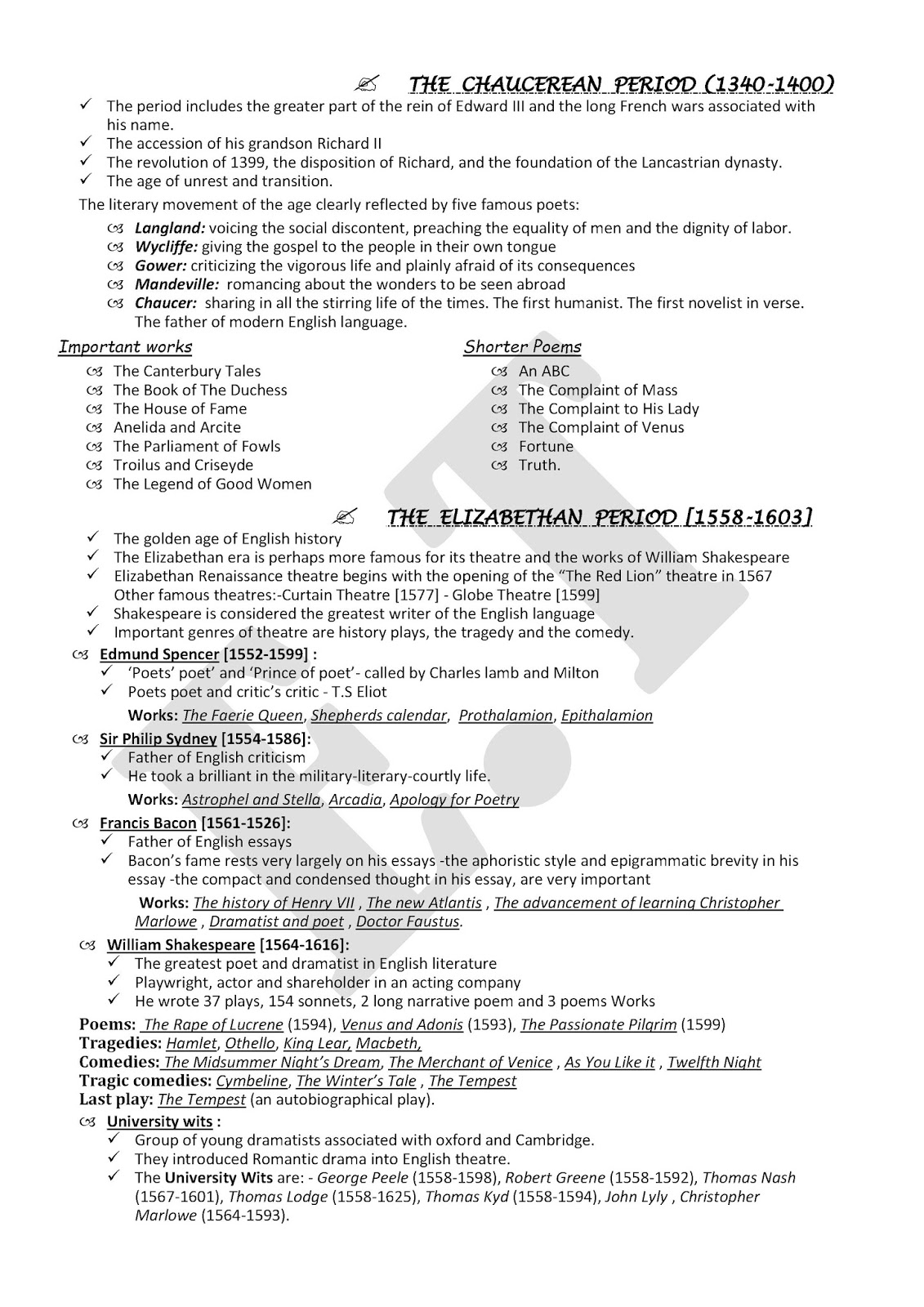
?   THE  CHAUCEREAN  PERIOD (1340-1400) 

  • The accession of his grandson Richard II
  • The period includes the greater part of the rein of Edward III and the long French wars associated with his name.
  • The age of unrest and transition.
  • The revolution of 1399, the disposition of Richard, and the foundation of the Lancastrian dynasty. 

The literary movement of the age clearly reflected by five famous poets:-

Wycliffe: giving the gospel to the people in their own tongue.
Mandeville:  romancing about the wonders to be seen abroad.
Chaucer:  sharing in all the stirring life of the times. The first humanist. The first novelist in verse. The father of modern English language.
Gower: criticizing the vigorous life and plainly afraid of its consequences.
Langland: voicing the social discontent, preaching the equality of men and the dignity of labor. 

Important works

The Canterbury Tales
The Book of The Duchess
The House of Fame
Anelida and Arcite
The Parliament of Fowls
Troilus and Criseyde
The Legend of Good Women

Shorter Poems
An ABC
The Complaint of Mass
The Complaint to His Lady
The Complaint of Venus
Fortune
Truth.

?   THE  ELIZABETHAN  PERIOD [1558-1603] 

The golden age of English history
Shakespeare is considered the greatest writer of the English language
The Elizabethan era is perhaps more famous for its theatre and the works of William Shakespeare
Elizabethan Renaissance theatre begins with the opening of the “The Red Lion” theatre in 1567 Other famous theatres:-Curtain Theatre [1577] - Globe Theatre [1599]

Important genres of theatre are history plays, the tragedy and the comedy.

William Shakespeare [1564-1616]:

ü  The greatest poet and dramatist in English literature
ü  Playwright, actor and shareholder in an acting company
ü  He wrote 37 plays, 154 sonnets, 2 long narrative poem and 3 poems Works 
ü  
 Poems:  The Rape of Lucrene (1594), Venus and Adonis (1593), The Passionate Pilgrim (1599)

  Tragedies: Hamlet, Othello, King Lear, Macbeth,

  Comedies: The Midsummer Night’s Dream, The Merchant of Venice , As You Like it , Twelfth Night

  Tragic comedies: Cymbeline, The Winter’s Tale , The Tempest

  Last play: The Tempest (an autobiographical play).


Edmund Spencer [1552-1599] :

ü  ‘Poets’ poet’ and ‘Prince of poet’- called by Charles lamb and Milton
ü  Poets poet and critic’s critic - T.S Eliot

            Works: The Faerie Queen, Shepherds calendarProthalamion, Epithalamion.

Sir Philip Sydney [1554-1586]:

ü  Father of English criticism
ü  He took a brilliant in the military-literary-courtly life.

             Works: Astrophel and Stella, Arcadia, Apology for Poetry

Francis Bacon [1561-1526]:
ü  Father of English essays
ü  Bacon’s fame rests very largely on his essays -the aphoristic style and epigrammatic brevity in his essay -the compact and condensed thought in his essay, are very important

            Works: The history of Henry VII , The new Atlantis , The advancement of learning Christopher    Marlowe , Dramatist and poet , Doctor Faustus.

University wits :   

ü  Group of young dramatists associated with oxford and Cambridge.
ü  They introduced Romantic drama into English theatre.
ü  The University Wits are: - George Peele (1558-1598), Robert Greene (1558-1592), Thomas Nash (1567-1601), Thomas Lodge (1558-1625), Thomas Kyd (1558-1594), John Lyly , Christopher Marlowe (1564-1593).

?   JACOBEAN  PERIOD [1603-1625]

ü  James ascended the throne in 1603
ü  Court standards were lowered
ü  Development of English prose
ü  Decline of the drama after the death of Shakespeare.

ü  Important events from Jacobean to restoration period: Caroline age, Metaphysical age, Puritan revolution, Puritan age, Period of commonwealth.

The cavalier poets
Edmund Waller:-Go Lovely Rose
Richard Lovelace:- Lucasta , To Alter From Prison
Robert Herrick:- Hesperides , Noble Numbers

            Metaphysical poets
Abraham Cowley:The Mistress
Andrew Marvell: The Rehearsal Transposed
John Donne:
Henry Vaughan: Silex Saintillans.

?   PURITAN  PERIOD [1649-1660]

ü Clash between Catholics and Protestants
ü Extreme fundamentalism
ü 1649-1660-Rule of commonwealth under Oliver Cromwell
ü Civil war between Charles I and Puritans for 7 years
ü Charles I ascended the throne after the death of Cromwell ; beginning of Restoration period
ü Rebellion began during the age of Charles I.

John Milton:

ü  The first literary epic poet
ü  Poetry , mathematics and music were his main studies

Works:  Paradise Lost, Paradise Regained, Comus, On Blindness, Lycidas

?   RESTORATION  POERIOD [1660-1700]
ü  Death of Cromwell in 1660
ü  Influence of French culture Theatres came back to life
ü  Witty intellectual satirizing manners and fashions of a particular time in society
ü  Accession marked the beginning of the Restoration Age

John Dryden:-The Rival Ladies, Tyrannick Love, All for Love
William Wycherley:-Love in a Wood, The Gentleman Dancing, Master
George Etherege:-The Comical Revenge , She Would If She Could.
William Congreve:-The Old Bachelor , The Double Dealer , The Mourning Bride

?   AUGUSTAN  AGE [1700-1785] 

ü  Strong traditionalism
ü  To them poetry was an imitation of human life
ü  Rise and fall of satires
ü  Rise of novels
ü  Conceived literature primarily as an art
ü  New developments in science shattered man’s ego

Oliver Goldsmith:-She Stoops to Conquer, The Deserted Village, The Man in Black
Dr. Samuel Johnson:-Preface to Shakespeare, London, Rasellas
Daniel Defoe:-A True born English man , Robinson Crusoe, Raxona
Henry Fielding:-Joseph Andrews, Tom Jones, Amelia
Alexander Pope: An Essay on Criticism, The Rape of the Lock, Windsor Forest.

?   ROMANTIC  AGE [1785-1830]

ü English Romanticism came from Germany
ü  Love for external nature
ü  Interest in medievalism
ü  Inaugurated with the publication of the Lyrical Ballads(1798)
ü  Revival of lyricism
ü  The influence of French literature
ü  Give importance to subjectivity

William Wordsworth: The Prelude, The Excursion, Immortality Ode
Lord Byron: Child Harold’s Pilgrimage , House of Idleness Cain
Mercy Bysshe Shelly: Ode to The West Wind ,Prometheus, Unbound
John Keats: Isabella , Hyperion, Lamia , Ode to Nightingale
Jane Austen: Pride and Prejudice, Emma.
Samuel Taylor Coleridge: Biographia Literaria , Kubla Khan , Scholar , Life of Nelson , Roderick

?   VICTORIAN  PERIOD [1830-1901]

ü  It extends to the death of Queen Victoria
ü  Mood of Nationalistic power
ü  Spiritual conflicts was evident
ü  Publication of Origin of Species
ü  Industrial Revolution
ü  Social stress

Robert Browning:-The Lady of Shallot ,Fra Lippo Lippi , Men and Women
Mathew Arnold:-Dover Beach , Scholar Gypsy , Essays on Criticism
Charles Dickens:-David Copperfield ,Dickwide Papers, Hard times
Thomas Hardy:-Tess of D’Umbervilles ,Far from the Madding Crowd
Lord Tennyson: Ulysses, Lotus Eaters , Idllus of the King .

?   THE  MODERN  PERIOD [1890-1918] 
ü  Break with tradition
ü  Rejected Romantic conventions
ü  Traditional verse patterns were rejected
ü  The catastrophe of the world wars had shaken faith in moral and spiritual life

T. S. Eliot:- Ash Wednesday, The Hollow Man, The Waste Land, Murder in the Cathedral
W. B .Yeats:- Sailing to Bysantium, September 1913
Ezra Pound:- Cantos
W .H. Auden:-Age of Anxiety , Look Stranger
D .H. Lawrence:-Sons And Lovers, Rainbow, Women in Love.


Page-1

Page-2

Page-3

Page-4
Thank you for watching. Comment for feedback or any suggestion ...
Share: