Monday, 22 October 2018

The Birthday Party

.


At a glance

Harold Pinter was working as an actor in England when he stayed briefly at a dilapidated boardinghouse that would serve as his inspiration for both The Birthday Party and The Room. As he has explained in many published works, he wrote more from intuition than from intellect, exploring his characters without pre-decided narratives in mind, and this one encounter was inspirational not because of people he met there, but because of a certain visceral feeling it gave him.

Pinter wrote The Birthday Party in 1957, after his one act play The Room attracted the attention of Michael Codron, a producer who saw much promise in the quirky playwright. The Birthday Party is Pinter’s first full length play, and the first of three plays considered his “comedy of menace” pieces. The other two are The Caretaker and The Homecoming.

"Comedy of menace," a term coined by critic Irving Wardle, describes a play which paints a realistic picture while creating a subtext of intrigue and confusion, as if the playwright were employing a sleight-of-hand trick. Pinter once said, “What I write has no obligation to anything other than to itself,” which both belies the designation Wardle gave his plays, and acknowledges the originality that inspired such a designation in the first place. Inspired by other unconventional playwrights such as Samuel Beckett, Pinter transcended traditional theater by staging a familiar setting (the English home) and then throwing it into a state of confusion with lies, deceit, and chaos. These juxtapositions would be further explored by Martin Esslin in his seminal study Theatre of the Absurd.

The Birthday Party premiered in Cambridge's Arts Theater on April 28, 1958, with Willoughby Gray as Petey and Richard Pearson as Stanley. Pinter directed the initial productions himself, but Peter Wood took his place as director once the play hit the pre-London stage. Though the play was received well in Cambridge, it was a resounding failure during its run at the Lyric Opera House in Hammersmith. The avant-garde writing and the confusing subtext sat poorly with critics and audiences alike..


.
.Summary

Act I

The play begins in the living room of a seaside boardinghouse in 1950s England. Petey, the boardinghouse owner, and his wife Meg, both in their sixties, sit at the living room table and engage in tepid conversation while eating breakfast. Meg is an inquisitive character who peppers Petey with repeated questions concerning his food, his job, etc. Petey informs his wife that two gentlemen will soon arrive to stay at the boardinghouse; he met them the night before. Meg is flustered by the news at first, but quickly recovers to promise she will have a room ready for them.

She then calls out to Stanley Webber, their boarder who is asleep upstairs. When he doesn’t answer, she goes upstairs to fetch him, and then returns a bit disheveled but amused. Stanley, a bespectacled, unkempt, surly man in his thirties, soon follows. Petey and Stanley speak of mundane topics while Meg prepares cornflakes and fried bread for Stanley’s breakfast. After Petey leaves for work, the atmosphere changes. Meg flirts with Stanley, who jokingly calls her “succulent” while criticizing her housework. When Meg becomes affectionate, he rudely pushes her away and insults her. Meg then informs him that two gentlemen are coming. The news unsettles Stanley, who has been the only boarder for years. He accuses Meg of lying, but she insists that she speaks the truth.

Before Meg leaves to shop, Lulu, a young girl in her twenties, arrives with a package. Meg instructs Lulu to keep the package from Stanley, and then she leaves. Lulu and Stanley chat for a little while, mostly about Stanley’s lack of enthusiasm and his appearance. Lulu calls him a “wash out” and then quickly exits. Stanley washes his face in the kitchen, and then leaves by the kitchen door. In the meantime, Goldberg and McCann enter the living room. They are the two gentlemen who had requested rooms for the evening.

It becomes immediately apparent that Goldberg and McCann have come under mysterious circumstances to “finish a job.” The job in question seems to be Stanley, though details are scarce. Goldberg reassures McCann that they are at the right house, and that this job will cause no more stress than their jobs usually cause them. Goldberg rambles on about his uncle until Meg arrives, and introductions are made.

Goldberg’s sweet temperament and suave demeanor soon set Meg at ease. Goldberg asks after Stanley, and Meg tells him that Stanley was once a successful pianist but had to give it up. Meg also reveals that it is Stanley’s birthday, and Goldberg suggests they have a party. Thrilled with the idea, Meg shows the gentlemen to their room. Later, Stanley returns to the living room as Meg arrives to put the groceries away. She tells him about the two gentlemen, and Stanley is visibly upset to learn Goldberg’s name. To cheer him up, Meg suggests he open his birthday present, even though Stanley insists that it is not his birthday. To humor Meg, he opens the package and finds a toy drum with drumsticks. He hangs the drum around his neck and parades around the table beating the drum merrily until his rhythm becomes erratic and chaotic. He beats the drum possessively and looms over Meg with a crazed expression on his face.

Act II

Later that same evening, McCann sits at the living room table shredding a newspaper into five equal strips. Stanley arrives, and the two men awkwardly greet one another. McCann, in a calm tone of voice, congratulates Stanley on his birthday, and says it is an honor to be invited to his party. Stanley replies that he wants to spend the evening alone and tries to leave, but McCann will not let him.

Stanley sits at the table and touches one of the newspaper strips, which upsets McCann. Stanley speaks of his past, and suggests he has never been one to cause trouble. Stanley insists that he has met McCann before, and grows upset when McCann denies the connection. Stanley wants to know why he and Goldberg are at the boardinghouse, and grows frantic when McCann claims they are there on a short holiday. Desperate, Stanley grabs McCann’s arm, who violently hits him off. Shocked into submission, Stanley calms himself and speaks of his love for Ireland, for its people, its sunsets, and its police. He asks McCann to accompany him to a nearby pub, but is interrupted when Petey and Goldberg enter the room.

Petey introduces Stanley to Goldberg, and then leaves. The situation in the room grows tense, as Goldberg yammers on about his past. Despite Goldberg’s soothing words, Stanley remains on edge and refuses to sit down when McCann asks him to. It is not McCann's threats that convince him to sit, but rather Goldberg's quiet insistence.

After Stanley submits, Goldberg and McCann interrogate him about his past - they accuse him of betraying their “organization,” of killing his wife, of leaving his bride at the altar, of being a waste of space, and more. Stanley answers at first, but is soon struck dumb by the sheer number of questions being thrown at him. The questions grow progressively more ridiculous and nonsensical. Finally, Stanley hits Goldberg in the stomach. McCann and Stanley threaten each other with chairs, but are cooed back into civility when Meg arrives, beating Stanley’s toy drum. She is dressed for his birthday party. Goldberg compliments her, and the tense atmosphere quickly dissipates as Meg makes a moving tribute to Stanley in a toast while McCann flashes a torch in Stanley’s face like a spotlight. Lulu arrives, and Goldberg gives a second toast which includes more reminiscing.

The party begins in earnest. Lulu and Goldberg flirt, while Meg and McCann speak of Ireland. Stanley sits alone at the table until Meg suggests they all play blind man’s bluff. During Stanley’s turn, he is blindfolded by McCann, who breaks his glasses and puts the toy drum in his path so that Stanley’s foot smashes through it. When Stanley reaches Meg, he begins to strangle her. Goldberg and McCann pull him off, but then the lights suddenly go out. In the darkness, the two gentlemen cannot find Lulu, who has screamed and fainted. McCann shines his flashlight on the table to discover Stanley standing over Lulu as though about to sexually assault her. He giggles manically as the men slowly approach him and the curtain closes.

Act III

The next morning, Petey sits at the living room table reading a newspaper, while Meg frets about having no breakfast food left. Her memory is hazy from the night before, and she forgets that Petey was not there as she tries to remember what happened. When she leaves to shop, she sees Goldberg's car in the driveway, and grows frightened. Petey calms her down.

As Meg prepares to leave again, Goldberg enters the room and sits at the table. Meg asks him about the car, but he ignores her. She finally leaves. Petey asks Goldberg about Stanley, and Goldberg explains that Stanley suffered a nervous breakdown, and needs to be taken to a doctor whom Goldberg knows. Petey wants to see Stanley when he wakes, despite Goldberg's insistence that he should simply leave for work.

McCann enters with two suitcases, and tells Goldberg that Stanley is trying to fit his broken glasses into his eyes. When Petey suggests a way to fix the glasses and offers to fetch a doctor, Goldberg dismisses him. Petey departs to tend to his peas, insisting he be told when Stanley wakes, and Goldberg sits slumped over the table.

McCann demands they expedite the job, but Goldberg ignores him. Angry, McCann shakes Goldberg's chair and calls him "Simey," which causes the latter to attack him. McCann pacifies Goldberg, who then admits he feels poorly and is confused by the feeling. He tells McCann about his father and about his own principles on family, and finally makes a strange request by asking McCann to blow into his mouth twice. McCann does so without question, and Goldberg is calmed.

Lulu enters, and McCann leaves them alone. Lulu accuses Goldberg of having taken sexual advantage of her the night before. They argue over blame until McCann reenters and tells Lulu to confess her sins. Startled by this bizarre turn of events, Lulu flees. McCann then leaves to fetch Stanley, who enters cleanly shaven and nicely dressed. The two men seem to take pity on Stanley, and Goldberg promises to buy him new glasses. In a reprise of the interrogation from Act II, they pepper Stanley with gentler questions and comments. Goldberg asks Stanley if he wants to leave with them, but Stanley can only muster gurgling sounds. They begin to exit with Stanley, but Petey arrives and tells them to stop. Menacingly, they ask Petey if he wants to accompany them. Petey allows the two men to take Stanley away, but before they leave, he cries out “Stan, don’t let them tell you what to do!”

Afterward, Petey returns to the living room table and picks up his newspaper. Meg arrives and asks if Stanley has come down to breakfast yet. Petey lies and tells her Stanley is still sleeping.


Themes


Atonement
One of the great ironies in this play is that it uses what appears to be a fairly undramatic, realistic setting which nevertheless hides a surplus of guilt. The theme of atonement runs throughout the play. Stanley's past is never detailed, but he is clearly a guilty man. He is vague about his past, and does anything to distract Goldberg and McCann. He does not wish to atone for whatever he did, but is forced to do so through torture. Goldberg, too, wishes to avoid whatever sins torture him but cannot fully escape them; his mood in Act III shows that he is plagued by feelings he does not wish to have. In the end, all of the characters are like Lulu, who flees when McCann offers her a chance to confess - everyone has sins to atone for, but nobody wants to face them.

Complacency
Perhaps the most pessimistic aspect of The Birthday Party is that the only alternative Pinter gives to chaos and confusion is a life of apathy and complacency. The play's opening sets this up - Petey and Meg reveal a comfortable but bland life in which they talk in pleasantries and ignore anything of substance. Stanley might be more aggressive than they are, but he too has clearly chosen the safety of complacency, as he makes no effort to change his life. His lethargic lifestyle reflects the attraction comfort has for him. When Goldberg and McCann arrive, they challenge this complacent lifestyle until the whole place falls into chaos. Ultimately, Petey chooses to refortify the complacency of the boardinghouse over bravely fighting for Stanley; neither choice is truly attractive.

Confusion and Chaos
A key element of “the absurdist theater” is its focus on confusion and chaos. In The Birthday Party, these elements manifest constantly, especially through its characters.

The primary way in which the themes manifest are through the ambiguities of lives and pasts. Stanley has some sort of mysterious past that deserves a violent reckoning, but nobody really provides its details. When Stanley describes his past to Meg in Act I, there is even the sense that he himself is confused about its particulars. Goldberg's name and past seem shrouded in mystery and delusion, and Meg convinces herself to believe things about her life that are clearly not true. Further, because of these type of confusions, the situation devolves into total chaos. From the moment Goldberg and McCann arrive, the audience can sense that the simplicity of the boardinghouse is about to be compromised, and indeed, the chaos at the end of Act II confirms it.
The only truth of The Birthday Party is that there is no truth, only chaos and confusion from which we make order if we choose.


Language
The precision Pinter employs in crafting his rhythmic silences is enough to justify language as a major theme, but he moreover reveals how language can be used as a tool. Each of the characters uses language to his or her advantage. In effect, characters manipulate words to suggest deeper subtexts, so that the audience understands that true communication happens beneath language, and not through words themselves. When Stanley insults Meg, he is actually expressing his self-hatred and guilt. Goldberg is a master of language manipulation - he uses speeches to deflect others questions, to redirect the flow of conversation, or to reminisce about past events. His words are rarely wasted. Meg, on the other hand, repeats herself, asking the same questions over and over again in a bid for attention. Even though she often speaks without affectation, her words mask a deep neurosis and insecurity. These are just a few examples of instances in which language is used not to tell the story, but to suggest that the story is hidden. In essence, language in The Birthday Party is a dangerous lie.


Nostalgia
Perhaps most fitting for a contemporary audience who would see this play as something of a period piece, the theme of nostalgia is implicit but significant in The Birthday Party. Goldberg, particularly, is taken by nostalgia, frequently waxing poetic both on his own past and on the 'good old days' when men respected women. Certainly, Goldberg tells some of these stories to contrast with the way Stanley treats women, but they also suggest a delusion he has, a delusion that breaks down when he himself assaults Lulu between the second and third acts. He idealizes some past that he cannot live up to.

Other characters reveal an affection for nostalgia as well. During the birthday party, Meg and Lulu both speak of their childhoods. However, their nostalgic feelings have darker sides. Meg remembers being abandoned, whereas Lulu's memories of being young lead Goldberg to bounce her perversely on his knee. Similarly, the characters play blind man's bluff specifically because it makes them nostalgic, but the sinister side of such nostalgia is inescapable in the stage image of Stanley preparing to rape Lulu. Nostalgia is lovely to feel, the play seems to suggest, but more insidious in its complexities.

Much of the violence in the play concerns women. Stanley not only intimidates Meg verbally, but he also prepares to assault Lulu. Goldberg in fact does assault Lulu. Finally, the threat of violence is ever-present in the play. Even before we realize that disaster might come, we can feel the potential through the many silences and tense atmosphere.

Sex
Sexual tension is present throughout the entire play, and it results in tragic consequences. Meg and Stanley have a strange, possible sexual relationship that frees him to treat her very cruelly. The ugliness of his behavior is echoed when Goldberg calls him a “mother defiler” and “a lecher.” In fact, Goldberg suggests that Stanley's unnamed sin involves his poor treatment of a woman. Lulu seems interested in Stanley as well, but is quickly attracted to Goldberg in Act II. Her innocence makes her prey to men's sexuality. Her openness leads to two consecutive sexual assaults, and yet she is nevertheless upset to learn that Goldberg is leaving. All in all, it is a strange, perverse undercurrent throughout the play - sex is acknowledged as a fact of life, and yet does not ever reveal positive aspects of the characters.

Violence
The Birthday Party is full of violence, both physical and emotional, overall suggesting that violence is a fact of life. The violence is doubly affecting because the setting seems so pleasant and ordinary. Most of the men show their potential for violence, especially when provoked. Stanley is cruel and vicious towards Meg, but much more cowardly against other men. Both McCann and Goldberg have violent outbursts no matter how hard they try to contain themselves. Their entire operation, which boasts an outward civility, has an insidious purpose, most violent for the way it tortures Stanley slowly to force him to nervous breakdown. In both Acts II and III, they reveal how language itself can be violent in the interrogation scenes.


.
.
.
.Characters

Petey
Petey Boles is the owner of the rundown boarding house in which the play takes place. He is 60 years old and married to Meg. Petey works a deckchair attendant at an unspecified seaside resort near his home on the shores of England.

As the play continues, Petey’s character is revealed to be more astute. He realizes that Goldberg and McCann are more insidious than they seem, and probably knows of his wife and Stanley's strange relationship. While Petey seems to know quite a lot more than he lets on, he ultimately reveals that he will do little to compromise the comfortable, delusional existence he shares with Meg.

Meg
Meg Boles is a kind woman who helps run the boardinghouse. She is sixty years old and married to Petey in a seemingly childless marriage. Absentminded and simplistic, Meg often asks repetitive questions and constantly requires attention. While she does carry on a sexually-tinged relationship with Stanley, Meg lives a rather humdrum life that allows her to maintain certain delusions about her attractiveness and popularity, delusions which she works hard to protect even as the play goes to darker places.

Stanley
Stanley Webber is ostensibly the protagonist of the play. He is the only boarder at the Boles's boardinghouse, and is initially defined by laziness, unkemptness, and smug cruelty towards Meg. The many details of his past are never confirmed - he might be a musician, might have been famous, etc. - although there is a sense that he has sins unatoned for. His aggressive depression transitions into a nervous breakdown when Goldberg and McCann arrive, until he is nothing but a bumbling idiot in Act III.


Goldberg's problems seem to be connected to his past - he is nostalgic about family, and waxes poetic about the old days. To what extent these delusions explain and/or feed his anger and violence are left to the reader's imagination.

McCann
Dermot McCann is an Irish member of an unnamed "organization" that has hired him to take Stanley away from the boardinghouse. Unlike Goldberg, who uses words and charm to his advantage, McCann is a paragon of bodily aggression. He lacks much social skill, and is something of a simpleton.

Goldberg
Nat Goldberg, also called “Simey” and “Benny,” is a Jewish gentleman who works for an unnamed "organization" that has employed him to take Stanley away from the boardinghouse. He is defined by his outwardly polite and suave demeanor, which stands in stark contrast to that of his associate McCann. However, he ultimately reveals an angry, violent streak beneath this suave demeanor.


Lulu
A young woman in her twenties, Lulu is an acquaintance of Meg’s and a visitor to the boardinghouse. She is childish and flirtatious, and though she seems initially interested in Stanley, she is easily attracted to Goldberg's charms. Her girlish qualities become ironically unsettling after she is sexually assaulted.
.
..


.
.Theater of the Absurd

Martin Esslin, a theater critic, coined the term “Theater of the Absurd” to describe a number of works being produced in the late 1950s and early 1960s that defied any traditional genres. The most famous playwright associated with this movement include Samuel Beckett, Eugene Ionesco, Jean Genet, and of course, Harold Pinter.

The term "absurd" was originally used by Albert Camus in his 1942 essay “Myth of Sisyphus,” wherein he described the human condition as “meaningless and absurd.” The key element to an absurdist play is that the main characters are out of sync with the world around them. There is no discernable reasoning behind their strangeness, though a threatening sense of change shakes their existence to the core.

Influences on the absurdist theater go as far back as the Elizabethan tragicomedies of Shakespeare and his contemporaries. The tragic plays Macbeth and Hamlet offer segments of comedy that shift the play's perspective, if only for the briefest moments. For example, Hamlet’s wit and the porter scene in Macbeth offer moments of comedy to alleviate the drama's intensity. Other influences on the absurdist playwrights include the work of Sigmund Freud, and the Surrealist movement of the 1920s and 1930s, which introduced the avant-garde to mainstream media.

However, the largest influence was World War II and its aftermath. Like Pinter, who was a child during the war, many Englishmen and women felt disillusioned once the war was over. They were angry and upset with the world, but found it difficult to express their collective opinions. In such a damaged world, it was no longer feasible to use traditional methods of storytelling on stage. The human condition was too complex and fragmented, and the old forms of language were hence inappropriate for exploring it.

To shake audiences from their more conventional viewing habits, the playwrights of the Absurdist Theater used traditional settings to ease the audience into their plays, and then shocked them with surreal imagery, uncommon circumstances, or fragmented language. Language within the Absurdist Theater often transcended its base meaning. As in The Birthday Party, nothing is as it seems and no one speaks the whole truth. Also, the use of silence as language was often utilized in these plays.

The drama of the absurdist theater is dreamlike, almost lyrical. Like the Surrealists before them, the absurdist playwrights use imagery, subtext, mythology, and allegory to express a deeper meaning which is often never fully explained. In fact, the playwrights of the Theater of the Absurd allowed their plays to speak for themselves. Pinter explained this absurdist concept best in his 1962 speech “Writing for the Theatre,” which was presented at the National Student Drama Festival in Bristol. He said, “I suggest there can be no hard distinctions between what is real and what is unreal, nor between what is true and what is false.” The thin line between truth and lies is perhaps the defining characteristic of the Theater of the Absurd.

.

.
Why is the play The Birthday Party by Harold Pinter absurdist?
Absurdist drama is about the illogical nature of the world and its lack of meaning. The main character in The Birthday Party, Stanley Webber, is an unemployed pianist, but he asks Meg, who runs the boarding house where he lives, "I haven't got a piano, have I?" Stanley is unaware of even the basic nature of his existence. Later, Stanley tells Meg, who is celebrating Stanley's birthday, "This isn't my birthday, Meg," even though she reassures him it is. Stanley is unsure even of when he was born, showing his alienation and uncertainty about the world. 
When two agents named Goldberg and McCann arrive to question Stanley, their questions veer into the absurd. Goldberg asks Stanley, "Who watered the wicket in Melbourne?" and McCann adds, "What about the blessed Oliver Plunkett?" Goldberg and McCann continue to ask questions that have no answers as they grill Stanley. They use this absurdism to torture Stanley. However, conversation in this play has no meaning, and words are only used to confuse people. The confusing nature of words supports the idea that the world is absurd and that the search for meaning is pointless. 


#Famous_literary_creations,  #Calcutta_University, #Kalyani_University, #Delhi_University,  #Vidyasagar_University,  #English_Literature, 
Share:

Wednesday, 10 October 2018

Beowulf


Beowulf


Beowulf is an Old English epic poem consisting of 3,182 alliterative lines. It is arguably one of the most important works of Old English literature. The date of composition is a matter of contention among scholars; the only certain dating pertains to the manuscript, which was produced between 975 and 1025. The author was an anonymous Anglo-Saxon poet, referred to by scholars as the "Beowulf poet".

The story is set in Scandinavia. Beowulf, a hero of the Geats, comes to the aid of Hrothgar, the king of the Danes, whose mead hall in Heorot has been under attack by a monster known as Grendel. After Beowulf slays him, Grendel's mother attacks the hall and is then also defeated. Victorious, Beowulf goes home to Geatland  and later becomes king of the Geats. After a period of fifty years has passed, Beowulf defeats a dragon, but is mortally wounded in the battle. After his death, his attendants cremate his body and erect a tower on a headland in his memory.

The full story survives in the manuscript known as the Nowell Codex. It has no title in the original manuscript, but has become known by the name of the story's protagonist. In 1731, the manuscript was badly damaged by a fire that swept through Ashburnham House in London that had a collection of medieval manuscripts assembled by Sir Robert Bruce Cotton. The Nowell Codex is currently housed in the British Library.


Beowulf, heroic poem, the highest achievement of Old English literature and the earliest European vernacular epic. It deals with events of the early 6th century and is believed to have been composed between 700 and 750. Although originally untitled, it was later named after the Scandinavian hero Beowulf, whose exploits and character provide its connecting theme. There is no evidence of a historical Beowulf, but some characters, sites, and events in the poem can be historically verified. The poem did not appear in print until 1815. It is preserved in a single manuscript that dates to circa 1000 and is known as the Beowulf manuscript

Beowulf falls into two parts. It opens in Denmark, where King Hrothgar’s splendid mead hall, Heorot, has been ravaged for 12 years by nightly visits from an evil monster, Grendel, who carries off Hrothgar’s warriors and devours them. Unexpectedly, young Beowulf, a prince of the Geats of southern Sweden, arrives with a small band of retainers and offers to cleanse Heorot of its monster. Hrothgar is astonished at the little-known hero’s daring but welcomes him, and, after an evening of feasting, much courtesy, and some discourtesy, the king retires, leaving Beowulf in charge. During the night Grendel comes from the moors, tears open the heavy doors, and devours one of the sleeping Geats. He then grapples with Beowulf, whose powerful grip he cannot escape. He wrenches himself free, tearing off his arm, and leaves, mortally wounded.

The next day is one of rejoicing in Heorot. But at night as the warriors sleep, Grendel’s mother comes to avenge her son, killing one of Hrothgar’s men. In the morning Beowulf seeks her out in her cave at the bottom of a mere and kills her. He cuts the head from Grendel’s corpse and returns to Heorot. The Danes rejoice once more. Hrothgar makes a farewell speech about the character of the true hero, as Beowulf, enriched with honours and princely gifts, returns home to King Hygelac of the Geats.

The second part passes rapidly over King Hygelac’s subsequent death in a battle (of historical record), the death of his son, and Beowulf’s succession to the kingship and his peaceful rule of 50 years. But now a fire-breathing dragon ravages his land and the doughty but aging Beowulf engages it. The fight is long and terrible and a painful contrast to the battles of his youth. Painful, too, is the desertion of his retainers except for his young kinsman Wiglaf. Beowulf kills the dragon but is mortally wounded. The poem ends with his funeral rites and a lament.

Beowulf belongs metrically, stylistically, and thematically to a heroic tradition grounded in Germanic religion and mythology. It is also part of the broader tradition of heroic poetry. Many incidents, such as Beowulf’s tearing off the monster’s arm and his descent into the mere, are familiar motifs from folklore. The ethical values are manifestly the Germanic code of loyalty to chief and tribe and vengeance to enemies. Yet the poem is so infused with a Christian spirit that it lacks the grim fatality of many of the Eddaic lays or the sagas of Icelandic literature. Beowulf himself seems more altruistic than other Germanic heroes or the ancient Greek heroes of the Iliad. It is significant that his three battles are not against men, which would entail the retaliation of the blood feud, but against evil monsters, enemies of the whole community and of civilization itself. Many critics have seen the poem as a Christian allegory, with Beowulf the champion of goodness and light against the forces of evil and darkness. His sacrificial death is not seen as tragic but as the fitting end of a good (some would say “too good”) hero’s life.

That is not to say that Beowulf is an optimistic poem. The English critic J.R.R. Tolkien suggests that its total effect is more like a long, lyrical elegy than an epic. Even the earlier, happier section in Denmark is filled with ominous allusions that were well understood by contemporary audiences. Thus, after Grendel’s death, King Hrothgar speaks sanguinely of the future, which the audience knows will end with the destruction of his line and the burning of Heorot. In the second part the movement is slow and funereal: scenes from Beowulf’s youth are replayed in a minor key as a counterpoint to his last battle, and the mood becomes increasingly sombre as the wyrd (fate) that comes to all men closes in on him.

Share:

Wednesday, 3 October 2018

The Nun's Priest's Tale 2

.
.
The Nun’s Priest’s Tale


.
Click here for the Summary and Analysis - The Nun's Priest's Tale 1
.
.


.Epilogue to The Nun's Priest's Tale

The Host, praises the tale as "myrie", and then, as he did with the Monk, suggests that the Nun's Priest would be an excellent breeding man (trede-foul) if only he were allowed to breed - for the Nun's Priest, the Host continues, is brawny, with a great neck and large chest.

Analysis

The Nun’s Priest’s Tale is one of the best-loved and best-known of all of the Tales, and one whose genre, in Chaucer’s time and now, is instantly recognizable. It is a beast fable, just like Aesop’s fable, and as one of Chaucer’s successors, the medieval Scots poet Robert Henryson, would go on to explore in great detail, its key relationship is that between human and animal. The key question of the genre is addressed at the end by the narrator himself: telling those who find a tale about animals a folly to take the moral from the tale, disregarding the tale itself. But can we take a human moral from a tale about animals? Can an animal represent – even just in a tale – a human in any useful way?

For a start, it is important to notice that the animal-human boundary is blurred even before the tale begins, when the Host mocks the Nun’s Priest (who, being a religious man, would have been celibate) and suggesting that he would have made excellent breeding stock (a “tredefowl”, or breeding-fowl, is the word he uses). The thought is an interesting one – because if we can think of the Nun’s Priest himself as potentially useful in breeding, animalistic terms, then can we think of his tale in potentially useful in human terms?

The question frames the other themes of the tale. The issue of woman’s counsel is raised again (last foregrounded in Chaucer’s tale of Melibee) explicitly – should Chaunticleer take Pertelote’s advice about how to interpret his dreams? Should he disregard his dreams, and get on with his life? He does, of course, looking among the cabbages (perhaps even to find herbs), when he sees the fox – and at that point, the tale seems to suggest, he should never have listened to his wife in the first place: his fears were valid.

That is, until we remember what the narrator tells us anyway at a crucial point, that his tale is “of a cok” – about a chicken. It is hardly as if we need a prophetic dream to tell us that foxes like eating chickens: its what we might call animal instinct. This is doubly highlighted when, after quoting Cato and discussing the various textual politics of dream interpretation, Chaunticleer calls his wives excitedly to him because he has found a grain of corn – and then has uncomplicated animal sex with Pertelote all night. It is a contradiction, Chaucer seems to imply, to expect unchicken-like behavior from a chicken: yet the contradiction is one which fuels the whole genre of beast fable. If the Nun’s Priest had too much human dignity and restraint to be a breeding fowl, Cato-quoting Chaunticleer has animal urges too strong to be a viable auctour.

Except that, of course, with the possible exception of Arviragus and Dorigen in the Franklin's Tale, there is no more stable and robust “marriage” in the Canterbury Tales than Chanticleer and Pertelote’s. The two fowl have a fulfilling sexual relationship - and the sex occurs as a pleasurable, uncomplicated end in itself, a stark contrast with the sexual transactions of the Franklin and the Wife of Bath’s tales. In one sense, then, the animals are not so bestial.

Interpreting dreams, incidentally, is a favorite theme of Middle English literature, and it frames a whole genre of poetry, known as “dream poems”, of which Chaucer himself wrote several (including the Book of the Duchess and the House of Fame). Dreams and text are closely intertwined, and – even in this tale – the way in which a dream poem juxtaposes the text of the dream with the text of the story is clear. Is a dream any more or less real than a tale? If we can take a moral from a tale, can we take one from a dream?

This tale is in many ways a return to the ground, a return to basics. We start with a poor widow, and a dusty yard - a setting far removed from the high-culture classical tragedies of the Monk. Moreover, the tale keeps emphasizing anality and bottoms - in Chaunticleer’s two examples of dreams-coming-true, a dung cart and a breaking ship’s “bottom” are the hinge of the story, and Pertelote’s advice to Chaunticleer is to take some “laxatyf” to clear out his humours. There is a good-natured sense of groundedness about this tale, a return – after the dark run of Monk (interrupted), before him the punishing Melibee (and interrupted Sir Thopas) and bitter Prioress – to the humour and warmth of the early tales. Yet its theme also darkly foreshadows the end of the tale-telling project itself.

If the tale, taken simplistically, does endorse prophetic dreams (though, as mentioned above, a look at the animal nature of its characters might be seen as parodying the whole concept!) then what is the “moral” that the narrator wants us to take away at the end? As ever, this isn’t totally clear. Yet one thing it might be is the importance of speaking or not speaking.

One of the things that makes Chaunticleer the morally-representative chicken a problem is the fact that he can speak and argue with his wife on the one hand, yet cry “cok! Cok!” when he sees a grain on the floor. He is both chicken and human, rather like Chaucer writes as both himself and as Nun’s Priest. The tale, however, is structured by people knowing when to speak and not knowing when to speak: Pertelote speaks out to wake Chaunticleer from his dream, Chaunticleer foolishly opens his mouth to sing for the fox when he is captured, and it is Chaunticleer’s final visitation of the trap that he himself fell into on the fox which causes him in turn to open his mouth – and let Chaunticleer go. Know when you should “jangle” (chatter) and know when to hold your peace.

It is a theme of course which points a sharp finger at the whole idea of a beast fable - the whole genre, we might argue, resting on the writer precisely ignoring the correct moments to have a character speak or not speak; and it also is a dangerous moral for the Tales as a whole. In a work of literature that constantly apes orality, the injunction to shut up is a serious one – and, as a comparison of the Nun’s Priest’s Tale to the Manciple’s Tale reveals – one very much in Chaucer’s mind at the very end of the Canterbury project.
.
.
.

Click here for the Summary and Analysis of The Nun's Prist's Tale - 

The Nun's Priest's Tale 1


.
Share:

Tuesday, 2 October 2018

The Nun's Priest's Tale

.
.
.
The Nun’s Priest’s Tale
.


The Nun’s Priest’s Tale, one of the 24 stories in The Canterbury Tales by Geoffrey Chaucer, “The Nun’s Priest’s Tale” is based on the medieval tale of Reynard the Fox, common to French, Flemish, and German literature.


The protagonist of this mock-heroic story is Chanticleer, a rooster with seven wives, foremost among them the hen Pertelote. Pertelote dismisses Chanticleer’s dream of being attacked and tells him to go about his business. A fox soon approaches and flatters him, recalling the exquisite song of Chanticleer’s father. The vain rooster is thus tricked into closing his eyes and crowing, only to be seized by the fox and carried off. As Chanticleer’s owners and the animals of the barnyard run after them, Chanticleer suggests that his captor yell to tell them to turn back. When the fox opens his mouth, the rooster escapes. The tale ends with a warning against flattery.
.
.
.

Summary

A poor widow, rather advanced in age, had a small cottage beside a grove, standing in a dale. This widow led a very simple life, providing for herself and her daughters from a small farm. In a yard which she kept, enclosed all around with palings and with a ditch outside it, she had a cock called Chaunticleer, who was peerless in his crowing. Chaunticleer was beautifully coloured, with a comb redder than coral, and a beak as black as jet, and he had under his government seven chickens, who were his paramours, of which his favourite was Dame Pertelote.

One morning, Chaunticleer began to groan in his throat, as a man who was troubled in his dreams does, and Pertelote, aghast, asked him what the matter was. Chaunticleer replied that he had had a bad dream, and prayed to God to help him to correctly interpret it. He had dreamt that he, roaming around the yard, saw an animal “lyk an hound” which tried to seize his body and have him dead. The “hound’s” colour was somewhere between yellow and red, and his tail and both his ears were tipped with black.

Pertelote mocked him, telling him that he was a coward. Pertelore then argues that dreams are meaningless visions, caused simply by ill humors (bad substances in the body) – and quotes Cato at length to demonstrate her point. Her solution is that she will pick herbs from the yard in order to bring his humors back to normal.

Chaunticleer disagreed, arguing that while Cato is certainly an authority, there are many more authorities available to be read who argue that dreams are significations – of good things and bad things to come. He stated the example of one man who, lying in his bed, dreamt that his friend was being murdered for his gold in an ox’s stall, and that his body was hidden in a dung cart. Remembering his dream, this man went to a dung cart at the west gate of the town, and found the murdered body of his friend. Chaunticleer then described the story of two men, who were preparing to cross the sea. One of them dreamed that, if he crossed the sea the next day, he would be drowned - he told his companion, who laughed at him, and resolved to go anyway. The ship’s bottom tore, and his companion was drowned. Chaunticleer also cited the examples of Macrobius, Croesus and Andromache, who each had prophecies in their dreams.

Then, however, Chaunticleer praised Pertelote, asking her to speak of “mirth”, and stop all this talk of prophecy - the beauty of her face, he says, makes him feel fearless. He then quoted the proverb “Mulier est hominis confusio”, translating it as “Woman is man’s joy and all his bliss”, when it actually translates “Woman is man’s ruin”. Chaunticleer then flew down from his beam, called all of his hens to him, and revealed that he’d found a grain lying in the yard. He then clasped Pertelote to him with his wings, and copulated with her until morning.

When the month of March was over, Chaunticleer was walking in full pride, all of his wives around him, when a coal fox (a fox with black-tipped feet, ears and tail) broke through the hedges and into the yard. He bode his time for a while. The narrator then goes off into an aside, addressing Chaunticleer, and wishing that he had taken “wommennes conseils” (woman’s counsel) – before he moves back into the tale, reminding us that his tale “is of a cok”.

Chaunticleer sang merrily in the yard, and, casting his eyes among the cabbages, caught sight of the fox – and would have fled, but the fox addressed him, asking where he was going, and claiming to be his friend. The fox claimed to have met Chaunticleer’s mother and father, and talked of his father’s excellent singing voice, and the way his father used to stretch out his neck and stand on his tiptoes before singing. The fox then asked whether Chaunticleer can sing like his father – and Chaunticleer stood on his tiptoes, stretched out his neck, closed his eyes, and, as he began to sing, the fox grabbed him by the throat and ran off to the wood with him.

The poor widow and her two daughters, hearing the cry of the chickens, ran after the fox toward the crove, and many other men and animals ran after them. Chaunticleer managed to speak to the fox, and encouraged him to turn to his pursuers and curse them, telling him that he was going to eat the cock. The fox agreed – but as he opened his mouth to agree, the cock broke from his mouth suddenly and flew high up into a tree. The fox tried to persuade him down, saying that he had been misinterpreted, and that Chaunticleer should fly down in order that he might “seye sooth” (tell the truth) about what he had meant, but Chaunticleer knew better this time. The fox finally cursed all those who “jangleth whan he sholde holde his pees”.


The narrator then addresses everyone who thinks the tale is mere foolery, asking them to take the moral of the tale, rather than the tale itself: taking the fruit, and letting the chaff remain. Thus ends the Nun’s Priest’s Tale.
.
.
.


Analysis

The Nun's Priest's Tale is one of Chaucer's most brilliant tales, and it functions on several levels. The tale is an outstanding example of the literary style known as a bestiary (or a beast fable) in which animals behave like human beings. Consequently, this type of fable is often an insult to man or a commentary on man's foibles. To suggest that animals behave like humans is to suggest that humans often behave like animals.

This tale is told using the technique of the mock-heroic, which takes a trivial event and elevates it into something of great universal import. Alexander Pope's poem The Rape of the Lock is an excellent example a mock-heroic composition; it treats a trivial event (the theft of a lock of hair, in this case) as if it were sublime. Thus when Don Russel, the fox, runs off with Chaunticleer in his jaws, the chase that ensues involves every creature on the premises, and the entire scene is narrated in the elevated language found in the great epics where such language was used to enhance the splendid deeds of epic heroes. Chaucer uses elevated language to describe a fox catching a rooster in a barnyard — a far cry from the classic epics. The chase itself reminds one of Achilles' chasing Hector around the battlements in the Iliad. To compare the plight of Chaunticleer to that of Homer's Hector and to suggest that the chase of the fox is an epic chase similar to classical epics indicates the comic absurdity of the situation.

The mock-heroic tone is also used in other instances: when the Nun's Priest describes the capture of the Don Russel and refers to the event in terms of other prominent traitors (referring to the fox as "a new Iscariot, a second Ganelon and a false hypocrite, Greek Sinon") and when the barnyard animals discuss high philosophical and theological questions. For Lady Pertelote and Chaunticleer to discuss divine foreknowledge in a high intellectual and moral tone in the context of barnyard chickens is the height of comic irony. We must also remember the cause of the discussion of divine foreknowledge: Lady Pertelote thinks that Chaunticleer's dream or nightmare was the result of his constipation, and she recommends a laxative. Chaunticleer's rebuttal is a brilliant use of classical sources that comment on dreams and is a marvelously comic means of proving that he is not constipated and does not need a laxative. Throughout the mock-heroic, mankind loses much of its human dignity and is reduced to animal values.

The Nun's Priest's ideas and positions are set up in his genially ironic attitude toward both the simple life of the widow and the life of the rich and the great as represented by the cock, Chaunticleer (in Chaucer's English, the name means "clear singing"). The Nun's Priest's opening lines set up the contrast. A poor old widow with little property and small income leads a sparse life, and it does not cost much for her to get along. The implication is that living the humble Christian life is easier for the poor than for the rich, who have, like Chaunticleer, many obligations and great responsibilities (after all, if Chaunticleer does not crow at dawn, the sun cannot rise).

The Nun's Priest contrasts the two human worlds of the poor and the rich in the description of the poor widow and the elegant Chaunticleer. The widow's "bour and halle" (bedroom) was "ful sooty," that is black from the hearth-flame where she had eaten many a slim or slender meal. Notice the contrast: The term "bour and halle" comes from courtly verse of the time and conjures up the image of a castle. The idea of a "sooty bower" or hall is absurd: The rich would never allow such a thing. Yet soot is inevitable in a peasant's hut, and from the peasant's point of view, the cleanliness fetish of the rich may also be absurd. A slender meal ("sklendre meel") would of course be unthinkable among the rich, but it is all the poor widow has. Likewise, the widow has no great need of any "poynaunt sauce" because she has no gamey food (deer, swan, ducks, and do on) nor meats preserved past their season, and no aristocratic recipes. She has "No dayntee morsel" to pass through her "throte," but then, when Chaucer substitutes the word "throat" ("throte) for the expected "lips," the dainty morsel that the image calls up is no longer very dainty. The aristocratic disease gout does not keep the widow from dancing, but it's unlikely that she dances anyway. Dancing is for the young or rich. As a pious lower-class Christian, she scorns dancing of all kinds. In short, the whole description of the widow looks ironically at both the rich and the poor.

When the Nun's Priest turns to Chaunticleer, he begins to comment on the life of the rich in other ironic ways. Chaunticleer has great talents and grave responsibilities, but the cock's talent (crowing) is a slightly absurd one, however proud he may be of it. (In middle English. as in modern, "crowing" can also mean boasting or bragging.) And Chaunticleer's responsibility, making sure the sun does not go back down in the morning, is ludicrous. His other responsibilities — taking care of his wives — are equally silly. Part of the Nun's Priest's method in his light-hearted analysis of human pride is an ironic identification of Chaunticleer with everything noble that he can think of. His physical description, which uses many of the adjectives that would be used to describe the warrior/knight (words such as "crenelated," "castle Wall," "fine coral," "polished jet," "azure," "lilies," and "burnished gold," for example) reminds one of an elegant knight in shining armor.


The reader should be constantly aware of the ironic contrast between the barnyard and the real world, which might be another type of barnyard. That is, the "humanity" and "nobility" of the animals is ironically juxtaposed against their barnyard life. This contrast is an oblique comment on human pretensions and aspirations in view of the background, made clear when Don Russel challenges Chaunticleer to sing, and the flattery blinds Chaunticleer to the treachery. Here, the tale refers to human beings and the treachery found in the court through flattery. Chaunticleer's escape is also effected by the use of flattery. Don Russel learns that he should not babble or listen to flattery when it is better to keep quiet. And Chaunticleer has learned that flattery and pride go before a fall.
.
.

.

Click here for Epilogue to The Nun's Priest's Tale - 

The Nun's Priest's Tale 2

.
.
.

.
.
Share:

Thursday, 20 September 2018

Norman Conquest 1066


.
.Norman Conquest 1066

The Norman conquest of 1066 ended Anglo-Saxon rule of England and installed a new king. The stage was set for the invasion when King Edward the Confessor died on January 5, 1066. He did not have any children so he had no heirs to take his place on the English throne.
.

Invasion of England

The conquest was the final act of a complicated drama that had begun years earlier, in the reign of Edward the Confessor, last king of the Anglo-Saxon royal line. Edward, who had almost certainly designated William as his successor in 1051, was involved in a childless marriage and used his lack of an heir as a diplomatic tool, promising the throne to different parties throughout his reign, including Harold Godwineson, later Harold II, the powerful earl of Wessex. The exiled Tostig, who was Harold’s brother, and Harald III Hardraade, king of Norway, also had designs on the throne and threatened invasion. Amid this welter of conflicting claims, Edward from his deathbed named Harold his successor on January 5, 1066, and Harold was crowned king the following day. However, Harold’s position was compromised, according to the Bayeux Tapestry and other Norman sources, because in 1064 he had sworn an oath, in William’s presence, to defend William’s right to the throne.

From almost the beginning of his reign, Harold faced challenges to his authority. Tostig began raiding the southern and eastern coasts of England in May, eventually joining forces with Harald III. Harold was able to keep his militia on guard throughout the summer but dismissed it early in September, when he ran out of supplies and his peasant soldiers needed to return to their fields for the harvest. This left the south without defenses, exposing it to invasion by William. Before William arrived, however, Harald III and Tostig invaded in the north; Harold hastened to Yorkshire, where at Stamford Bridge (September 25) he won a smashing victory in which both Harald III and Tostig perished.

Meanwhile, on the Continent, William had secured support for his invasion from both the Norman aristocracy and the papacy. By August 1066 he had assembled a force of 4,000–7,000 knights and foot soldiers, but unfavourable winds detained his transports for eight weeks. Finally, on September 27, while Harold was occupied in the north, the winds changed, and William crossed the Channel immediately. Landing in Pevensey on September 28, he moved directly to Hastings. Harold, hurrying southward with about 7,000 men, approached Hastings on October 13. Surprised by William at dawn on October 14, Harold drew up his army on a ridge 10 miles (16 km) to the northwest.

Harold’s wall of highly trained infantry held firm in the face of William’s mounted assault; failing to breach the English lines and panicked by the rumour of William’s death, the Norman cavalry fled in disorder. But William, removing his helmet to show he was alive, rallied his troops, who turned and killed many English soldiers. As the battle continued, the English were gradually worn down; late in the afternoon, Harold was killed (by an arrow in the eye, according to the Bayeux Tapestry), and by nightfall the remaining English had scattered and fled. William then made a sweeping advance to isolate London, and at Berkhamstead the major English leaders submitted to him. He was crowned in Westminster Abbey on Christmas Day, 1066. Sporadic indigenous revolts continued until 1071; the most serious, in Northumbria (1069–70), was suppressed by William himself, who then devastated vast tracts of the north. The subjection of the country was completed by the rapid building of a great number of castles.


Consequences of the Conquest

The extent and desirability of the changes brought about by the conquest have long been disputed by historians. Certainly, in political terms, William’s victory destroyed England’s links with Scandinavia, bringing the country instead into close contact with the Continent, especially France. Inside England the most radical change was the introduction of land tenure and military service. While tenure of land in return for services had existed in England before the conquest, William revolutionized the upper ranks of English society by dividing the country among about 180 Norman tenants-in-chief and innumerable mesne (intermediate) tenants, all holding their fiefs by knight service. The result, the almost total replacement of the English aristocracy with a Norman one, was paralleled by similar changes of personnel among the upper clergy and administrative officers.

Anglo-Saxon England had developed a highly organized central and local government and an effective judicial system (see Anglo-Saxon law). All these were retained and utilized by William, whose coronation oath showed his intention of continuing in the English royal tradition. The old administrative divisions were not superseded by the new fiefs, nor did feudal justice normally usurp the customary jurisdiction of shire and hundred courts. In them and in the king’s court, the common law of England continued to be administered. Innovations included the new but restricted body of “forest law” and the introduction in criminal cases of the Norman trial by combat alongside the old Saxon ordeals. Increasing use was made of the inquest procedure—the sworn testimony of neighbours, both for administrative purposes and in judicial cases. A major change was William’s removal of ecclesiastical cases from the secular courts, which allowed the subsequent introduction into England of the then rapidly growing canon law.

William also transformed the structure and character of the church in England. He replaced all the Anglo-Saxon bishops, except Wulfstan of Dorchester, with Norman bishops. Most notably, he secured the deposition of Stigand, the archbishop of Canterbury—who held his see irregularly and had probably been excommunicated by Pope Leo IX—and appointed in his place Lanfranc of Bec, a respected scholar and one of William’s close advisers. Seeking to impose a more orderly structure on the English episcopacy, the king supported Lanfranc’s claims for the primacy of Canterbury in the English church. William also presided over a number of church councils, which were held far more frequently than under his predecessors, and introduced legislation against simony (the selling of clerical offices) and clerical marriage. A supporter of monastic reform while duke of Normandy, William introduced the latest reforming trends to England by replacing Anglo-Saxon abbots with Norman ones and by importing numerous monks. Although he founded only a small number of monasteries, including Battle Abbey (in honour of his victory at Hastings), William’s other measures contributed to the quickening of monastic life in England.

Probably the most regrettable effect of the conquest was the total eclipse of the English vernacular as the language of literature, law, and administration. Superseded in official documents and other records by Latin and then increasingly in all areas by Anglo-Norman, written English hardly reappeared until the 13th century.
..
.
.
.
.
.
..
.
.
.
.

Share:

Tuesday, 24 April 2018

Ages of British English Literature


From the beginning to the Twenty first century, the British English literature can be divided into some periods or ages based on the time of writing, writing style, different nature and attitude. Of these, the important Periods are described below-


AGES OF ENGLISH LITERATURE


  • The old English [450AD -1066AD] 
  • The Middle English [1066AD-1500AD] 
  • The Renaissance period [1500-1600] 
  • The Elizabethan period [1558-1603] 
  • The Jacobean period [1603-1625] 
  • The Caroline period [1625-1649] 
  • The Puritan period [1649-1660] 
  • The Restoration period [1660-1700] 
  • The Augustan period [1700-1785] 
  • The Romantic period [1785-1830] 
  • The Victorian period [1830-1901] 
  • The Modern period [1890-1918] 
  • The Inter- war period [1918-1939] 
  • The Mid 20th century [1939 onwards]

?   THE  OLD  ENGLISH  PERIOD  [450-1066] 

             According to British traditions the English from the continent came first as mercenaries to help in the defense against the Picts and Scots.

  • Then followed the Christianization of the pagan English tribes
  • The establishment of the Dane law in English
  • The accession of a Danish king
  • The Norman influence on the English court when began before the conquest in 1066 

Beowulf: The theme of the poem is continental Germanic. The poem can be considered as the pagan origin. Work is anonymous.
Anglo- Saxon Chronicle: Inspired by King Alfred. Description of the horrors of Stephen's reign. Description of William the conqueror.

Authors
Ø  Caedmon (poet): The Genesis, Exodus, Daniel. Three shorter poems often considered as one under the title ‘Christ and Satan’.
Ø  Cynewulf (poet): Four poems contain the signature of Cynewulf in runic. Characters: Juliana, Elena, Christ, and the Fates of Apostles.

?   THE  MIDDLE  ENGLISH  PERIOD [1066AD-1500] 

  • Period of transition and of experiment
  • The transition
  • The anonymous nature Works are entirely without known authors
  • Internal struggle between king, clergy, noble and people General movements of the times:-the rise of the religious orders, the blossoming of chivalry, the spirit of romance, bringing new sympathy for women and poor, the crusades, widening European outlook, The Renaissance.
  • Establishment of Norman and Angevin dynasties.
  • The domination of poetry surviving works of the period is poetry.

Important Works
Ø  The vision of William concerning piers the plowman- William Langland
Ø  Brut- Lazamon

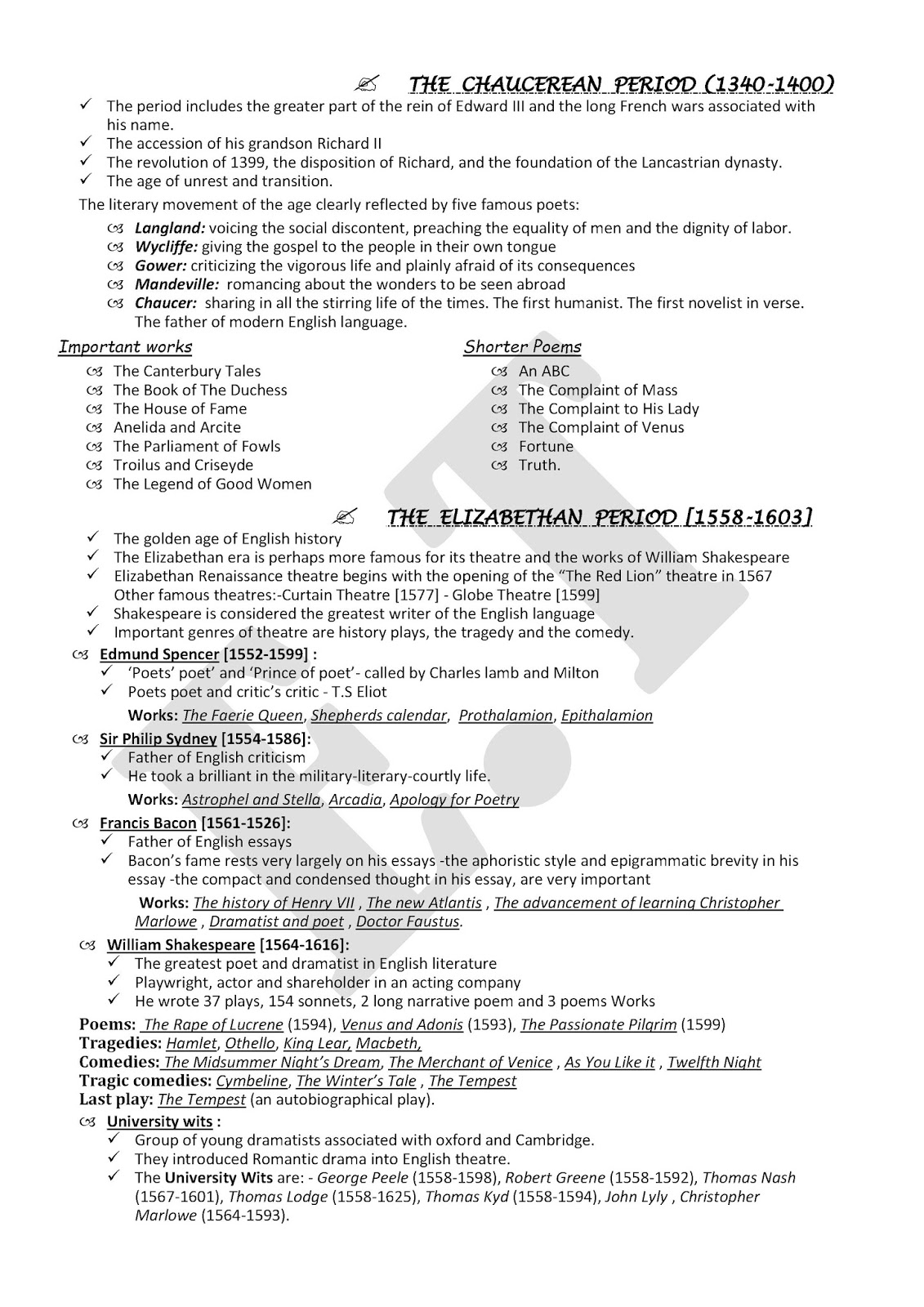
?   THE  CHAUCEREAN  PERIOD (1340-1400) 

  • The accession of his grandson Richard II
  • The period includes the greater part of the rein of Edward III and the long French wars associated with his name.
  • The age of unrest and transition.
  • The revolution of 1399, the disposition of Richard, and the foundation of the Lancastrian dynasty. 

The literary movement of the age clearly reflected by five famous poets:-

Wycliffe: giving the gospel to the people in their own tongue.
Mandeville:  romancing about the wonders to be seen abroad.
Chaucer:  sharing in all the stirring life of the times. The first humanist. The first novelist in verse. The father of modern English language.
Gower: criticizing the vigorous life and plainly afraid of its consequences.
Langland: voicing the social discontent, preaching the equality of men and the dignity of labor. 

Important works

The Canterbury Tales
The Book of The Duchess
The House of Fame
Anelida and Arcite
The Parliament of Fowls
Troilus and Criseyde
The Legend of Good Women

Shorter Poems
An ABC
The Complaint of Mass
The Complaint to His Lady
The Complaint of Venus
Fortune
Truth.

?   THE  ELIZABETHAN  PERIOD [1558-1603] 

The golden age of English history
Shakespeare is considered the greatest writer of the English language
The Elizabethan era is perhaps more famous for its theatre and the works of William Shakespeare
Elizabethan Renaissance theatre begins with the opening of the “The Red Lion” theatre in 1567 Other famous theatres:-Curtain Theatre [1577] - Globe Theatre [1599]

Important genres of theatre are history plays, the tragedy and the comedy.

William Shakespeare [1564-1616]:

ü  The greatest poet and dramatist in English literature
ü  Playwright, actor and shareholder in an acting company
ü  He wrote 37 plays, 154 sonnets, 2 long narrative poem and 3 poems Works 
ü  
 Poems:  The Rape of Lucrene (1594), Venus and Adonis (1593), The Passionate Pilgrim (1599)

  Tragedies: Hamlet, Othello, King Lear, Macbeth,

  Comedies: The Midsummer Night’s Dream, The Merchant of Venice , As You Like it , Twelfth Night

  Tragic comedies: Cymbeline, The Winter’s Tale , The Tempest

  Last play: The Tempest (an autobiographical play).


Edmund Spencer [1552-1599] :

ü  ‘Poets’ poet’ and ‘Prince of poet’- called by Charles lamb and Milton
ü  Poets poet and critic’s critic - T.S Eliot

            Works: The Faerie Queen, Shepherds calendarProthalamion, Epithalamion.

Sir Philip Sydney [1554-1586]:

ü  Father of English criticism
ü  He took a brilliant in the military-literary-courtly life.

             Works: Astrophel and Stella, Arcadia, Apology for Poetry

Francis Bacon [1561-1526]:
ü  Father of English essays
ü  Bacon’s fame rests very largely on his essays -the aphoristic style and epigrammatic brevity in his essay -the compact and condensed thought in his essay, are very important

            Works: The history of Henry VII , The new Atlantis , The advancement of learning Christopher    Marlowe , Dramatist and poet , Doctor Faustus.

University wits :   

ü  Group of young dramatists associated with oxford and Cambridge.
ü  They introduced Romantic drama into English theatre.
ü  The University Wits are: - George Peele (1558-1598), Robert Greene (1558-1592), Thomas Nash (1567-1601), Thomas Lodge (1558-1625), Thomas Kyd (1558-1594), John Lyly , Christopher Marlowe (1564-1593).

?   JACOBEAN  PERIOD [1603-1625]

ü  James ascended the throne in 1603
ü  Court standards were lowered
ü  Development of English prose
ü  Decline of the drama after the death of Shakespeare.

ü  Important events from Jacobean to restoration period: Caroline age, Metaphysical age, Puritan revolution, Puritan age, Period of commonwealth.

The cavalier poets
Edmund Waller:-Go Lovely Rose
Richard Lovelace:- Lucasta , To Alter From Prison
Robert Herrick:- Hesperides , Noble Numbers

            Metaphysical poets
Abraham Cowley:The Mistress
Andrew Marvell: The Rehearsal Transposed
John Donne:
Henry Vaughan: Silex Saintillans.

?   PURITAN  PERIOD [1649-1660]

ü Clash between Catholics and Protestants
ü Extreme fundamentalism
ü 1649-1660-Rule of commonwealth under Oliver Cromwell
ü Civil war between Charles I and Puritans for 7 years
ü Charles I ascended the throne after the death of Cromwell ; beginning of Restoration period
ü Rebellion began during the age of Charles I.

John Milton:

ü  The first literary epic poet
ü  Poetry , mathematics and music were his main studies

Works:  Paradise Lost, Paradise Regained, Comus, On Blindness, Lycidas

?   RESTORATION  POERIOD [1660-1700]
ü  Death of Cromwell in 1660
ü  Influence of French culture Theatres came back to life
ü  Witty intellectual satirizing manners and fashions of a particular time in society
ü  Accession marked the beginning of the Restoration Age

John Dryden:-The Rival Ladies, Tyrannick Love, All for Love
William Wycherley:-Love in a Wood, The Gentleman Dancing, Master
George Etherege:-The Comical Revenge , She Would If She Could.
William Congreve:-The Old Bachelor , The Double Dealer , The Mourning Bride

?   AUGUSTAN  AGE [1700-1785] 

ü  Strong traditionalism
ü  To them poetry was an imitation of human life
ü  Rise and fall of satires
ü  Rise of novels
ü  Conceived literature primarily as an art
ü  New developments in science shattered man’s ego

Oliver Goldsmith:-She Stoops to Conquer, The Deserted Village, The Man in Black
Dr. Samuel Johnson:-Preface to Shakespeare, London, Rasellas
Daniel Defoe:-A True born English man , Robinson Crusoe, Raxona
Henry Fielding:-Joseph Andrews, Tom Jones, Amelia
Alexander Pope: An Essay on Criticism, The Rape of the Lock, Windsor Forest.

?   ROMANTIC  AGE [1785-1830]

ü English Romanticism came from Germany
ü  Love for external nature
ü  Interest in medievalism
ü  Inaugurated with the publication of the Lyrical Ballads(1798)
ü  Revival of lyricism
ü  The influence of French literature
ü  Give importance to subjectivity

William Wordsworth: The Prelude, The Excursion, Immortality Ode
Lord Byron: Child Harold’s Pilgrimage , House of Idleness Cain
Mercy Bysshe Shelly: Ode to The West Wind ,Prometheus, Unbound
John Keats: Isabella , Hyperion, Lamia , Ode to Nightingale
Jane Austen: Pride and Prejudice, Emma.
Samuel Taylor Coleridge: Biographia Literaria , Kubla Khan , Scholar , Life of Nelson , Roderick

?   VICTORIAN  PERIOD [1830-1901]

ü  It extends to the death of Queen Victoria
ü  Mood of Nationalistic power
ü  Spiritual conflicts was evident
ü  Publication of Origin of Species
ü  Industrial Revolution
ü  Social stress

Robert Browning:-The Lady of Shallot ,Fra Lippo Lippi , Men and Women
Mathew Arnold:-Dover Beach , Scholar Gypsy , Essays on Criticism
Charles Dickens:-David Copperfield ,Dickwide Papers, Hard times
Thomas Hardy:-Tess of D’Umbervilles ,Far from the Madding Crowd
Lord Tennyson: Ulysses, Lotus Eaters , Idllus of the King .

?   THE  MODERN  PERIOD [1890-1918] 
ü  Break with tradition
ü  Rejected Romantic conventions
ü  Traditional verse patterns were rejected
ü  The catastrophe of the world wars had shaken faith in moral and spiritual life

T. S. Eliot:- Ash Wednesday, The Hollow Man, The Waste Land, Murder in the Cathedral
W. B .Yeats:- Sailing to Bysantium, September 1913
Ezra Pound:- Cantos
W .H. Auden:-Age of Anxiety , Look Stranger
D .H. Lawrence:-Sons And Lovers, Rainbow, Women in Love.


Page-1

Page-2

Page-3

Page-4
Thank you for watching. Comment for feedback or any suggestion ...
Share: